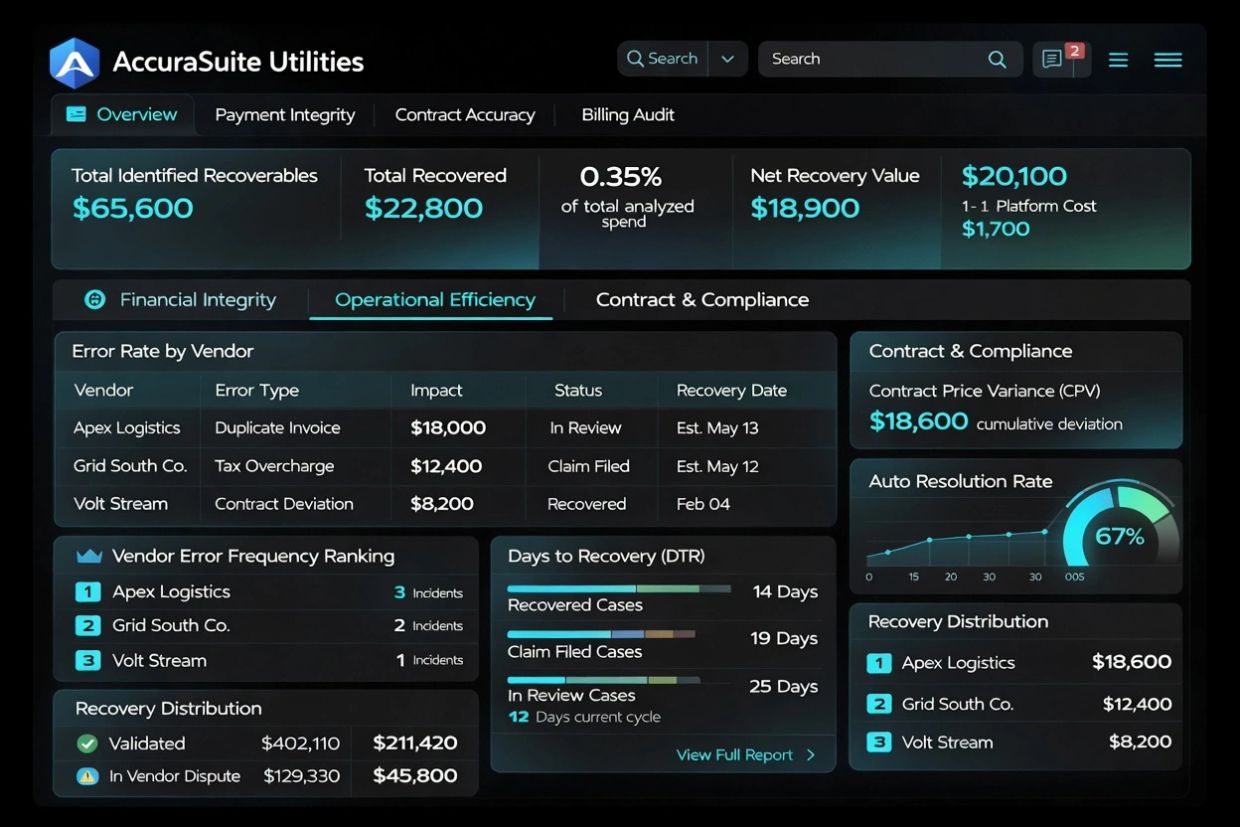
A utilities audit is a forensic review of electricity, natural gas, water, and sewer expenses designed to uncover billing errors, inefficiencies, and hidden cost recovery opportunities.
At VH, we combine tariff analysis, forensic bill auditing, and utility data intelligence to identify anomalies that often go unnoticed. We review usage patterns, demand charges, ratchets, taxes, riders, meter configurations, and billing structures to uncover refunds, credits, and long term savings opportunities without disrupting service.
Most organizations experience measurable savings through corrected billing structures, reduced utility waste, and ongoing monitoring that helps prevent unnecessary costs from returning.
Utilities are heavily regulated, but the complexity of tariffs, riders, meter rules, and billing calculations allows many costly errors to persist undetected.
Manufacturing & industrial operations
Healthcare & lab facilities
Universities & Education Campuses
Data centers & tech infrastructure
Local governments & public institutions
Large commercial real estate portfolios
Anyone spending more than our category minimums

Rising cyber risk and extreme weather are putting pressure on utility budgets.
Fiscal control is no longer optional. It is operational resilience.
Virgil Holding strengthens cash flow by auditing payments, vendors, and transaction data to uncover hidden inefficiencies.
We focus on contract and billing accuracy, using data analysis to recover overcharges and missed credits so funds stay aligned with critical infrastructure and long term reliability.
This approach turns historical spending into a clear, forward looking strategy for infrastructure investment.
Operational spending often goes unchecked over time.
A structured review exposes inefficiencies hidden within vendor invoices, subscriptions, and recurring billing systems.
Typical findings:
Virgil Holding applies a disciplined analysis framework to uncover inefficiencies across operational expenses, vendor relationships, and recurring billing systems.
Step 1 — Review
Financial records including invoices, payments, subscriptions, utilities, telecom, and insurance are examined.
Step 2 — Detect
Spending patterns are analyzed to identify duplicate charges, price increases, unused services, and billing errors.
Step 3 — Verify
Each issue is validated to confirm whether it is accurate or unnecessary.
Step 4 — Recover
Billing corrections, vendor negotiations, and contract adjustments are executed.
Step 5 — Save
Recovered funds and reduced expenses strengthen long term margins.
Copyright © 2026 Virgil Holding, LLC. All rights reserved. MSN Dynamics is a trademark of Virgil Holding, LLC and is operated by The Virgil Company.
Services | Audit Checklist | Resources | Contact | Mason Dynamics
We use cookies to analyze website traffic and optimize your website experience. By accepting our use of cookies, your data will be aggregated with all other user data.